
Tooth Extraction

WHY YOUR TOOTH NEEDS TO BE EXTRACTED?
- Tooth decay the makes it it impossible for the dentist to saved decaying tooth.
- Severe gum disease.
- Unfavorable tooth positioning to perform other dental procedures such as Orthodontics.
- Extraction to pave way for an erupting tooth underneath.
TREATMENT PROCEDURE
- Find a dentist to diagnose the need for dental extraction.
- In some cases, it may be necessary to have X-rays for diagnostic purposes.
- Dentists need to request a history of health to record information such as history of congenital disease, history of allergy, food allergies, or if there is a drug that needs to be regularly.
- Prepare the area of extraction. The dentist will inject local anesthesia to relieve pain.during treatment
- Dentists will start extracting tooth.
- The dentist will give advice on the treatment and after-care for the wound caused by the tooth extraction.
GUIDELINES AND PROCEDURES AFTER THE TOOTH EXTRACTION.
- Gently bite gauze for about 30-45 minutes until it fills up with blood, then change to a new gauze until active bleeding slows down or stops.
- Avoid mouthwash or direct icing. To compress, use an ice pack or cold gel to compress the outside cheek.
- Avoid alcoholic beverages and smoking.
- Avoid eating spicy foods during the first few days after tooth extraction.
- Extraction site can be cleaned normally. The area of the tooth extraction can be brushed, but with extra care.
- Alcohol-free mouthwash will be allowed, but only after at least 6 hours from extraction.
- If there is intolerable toothache, take painkillers as recommended by the dentist.
- Usually, patients can return home immediately after the treatment. The wound will be heal gradually. Usually within 7 days.
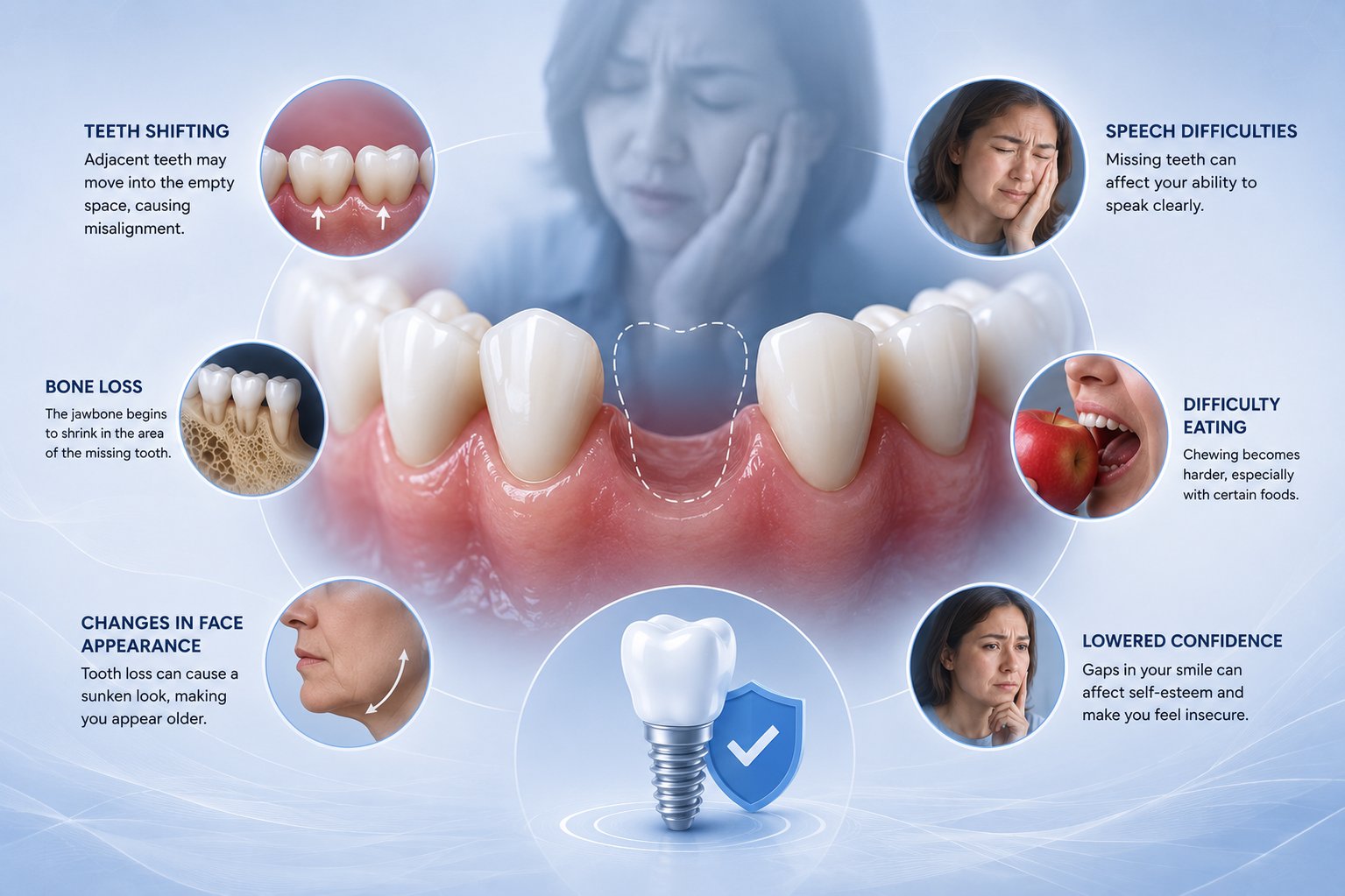
THE IMPACT OF TOOTH LOSS.
Loss of one or more tooth, unfortunately, may affect other the whole mouth. Gaps resulted from extraction will eventually alter the alignment of teeth, thus degrading normal function of teeth, such as chewing and physical distortion of facial profile.
These are the 2 most common alternatives that replace missing tooth:
- Implants
- Bridges
FAQ : Tooth Extraction
Q: What are the reasons for tooth extraction?
A: Tooth extraction is a last resort that dentists recommend if the tooth is impossible to keep or if it is necessary to carry out another dental procedure.
- Infection or inflammation of the gums or teeth.
- Risk of infection
- In preparation for another dental procedure.
Q: What are the contraindications and pre-dental preparation?
A: Patients who are at risk for severe infection may require antibiotics before and after tooth extraction. The dentist should be well informed of the
patient’s history of treatment including drugs and supplements being used or any underlying medical conditions.
Q: How many days to recover after tooth extraction?
A: The recovery time after tooth extraction usually takes 1-2 days.
WISDOM TOOTH EXTRACTION
WHAT IS WISDOM TOOTH?
Wisdom teeth is indeed a part of human dentition, it is sometimes referred to as the third molar, or the teeth the erupts at the very back side of the jaw. It usually comes up from age 17 – 25. In some cases, the wisdom tooth does not erupt properly, causing it to be impacted under the gums. This impaction can cause pain, swelling and infection. It can also obstruct occlusion for some people. There are other reasons why dentists might suggest wisdom tooth extraction.
The jaw is the last of the teeth. It will be around the age of 18-20 years, but most of it. This tooth usually can not come up normally. This makes teeth that the teeth. Even in the oral cavity of some patients, there may be enough space to allow the third molar tooth. Can come up or up all. However, if the dentist is diagnosed and see the risks. It will be followed later, such as difficult care, infection and inflammation or obstruction to the occlusion, etc. After a thorough analysis. The dentist may recommend removing the tooth. To prevent the spread of the causes mentioned above.
THE RISK OF DISEASES THAT MAY BE CAUSED BY INGROWN TEETH IS AS FOLLOWS.
- Tooth decay of adjacent teeth.
- Swollen gums caused by infections that can not be easily cleaned.
- Other diseases associated with gum and jaw.
SYMPTOMS THAT MAY BE CAUSED BY IMPACTED TEETH.
- Toothache.
- The gums are swollen or reddish in the uppermost position of the second molar.
- Neck or cheek swelling.
TREATMENT PROCEDURE
- Find a dentist for diagnosis. X-rays may also be used to diagnose conditions and signs.
- Dentists will ask for a history of health to record information such as history of congenital disease, drug allergies, food allergies, etc.
- Prepare the area to be operated. The dentist will give you a local anesthetic.
- The dentist will perform the treatment. At the end of the treatment process, the patient is sewn on the wound and oral cavity is washed.
- Your dentist will provide advice and care after surgery.
FAQ : TOOTH DECAY
Q : Can wisdom teeth not be removed?
A : Wisdom teeth are like time bombs that can erupt at any time. Therefore, it is advisable to have wisdom teeth removed while there is no pain.
It’s better than waiting for the pain to come and then come and cut it out. which will make the treatment more difficult The patient has more pain.
Q : If wisdom teeth begin to grow out of the gums. What are the symptoms?
A: Symptoms caused by wisdom teeth beginning to grow from the gums include
- gum pain
- infectious inflammation
- facial swelling
Q: In what kind of cases do I need to have wisdom teeth removed?
A: In the case of having wisdom teeth removed, there are the following
- Wisdom teeth affect the occlusion of the teeth.
- The teeth are not used for mastication, i.e. without a partner.
- Large decayed teeth
- Wisdom teeth can cause gum disease problems.
- Wisdom teeth make it difficult to restore the adjacent teeth.